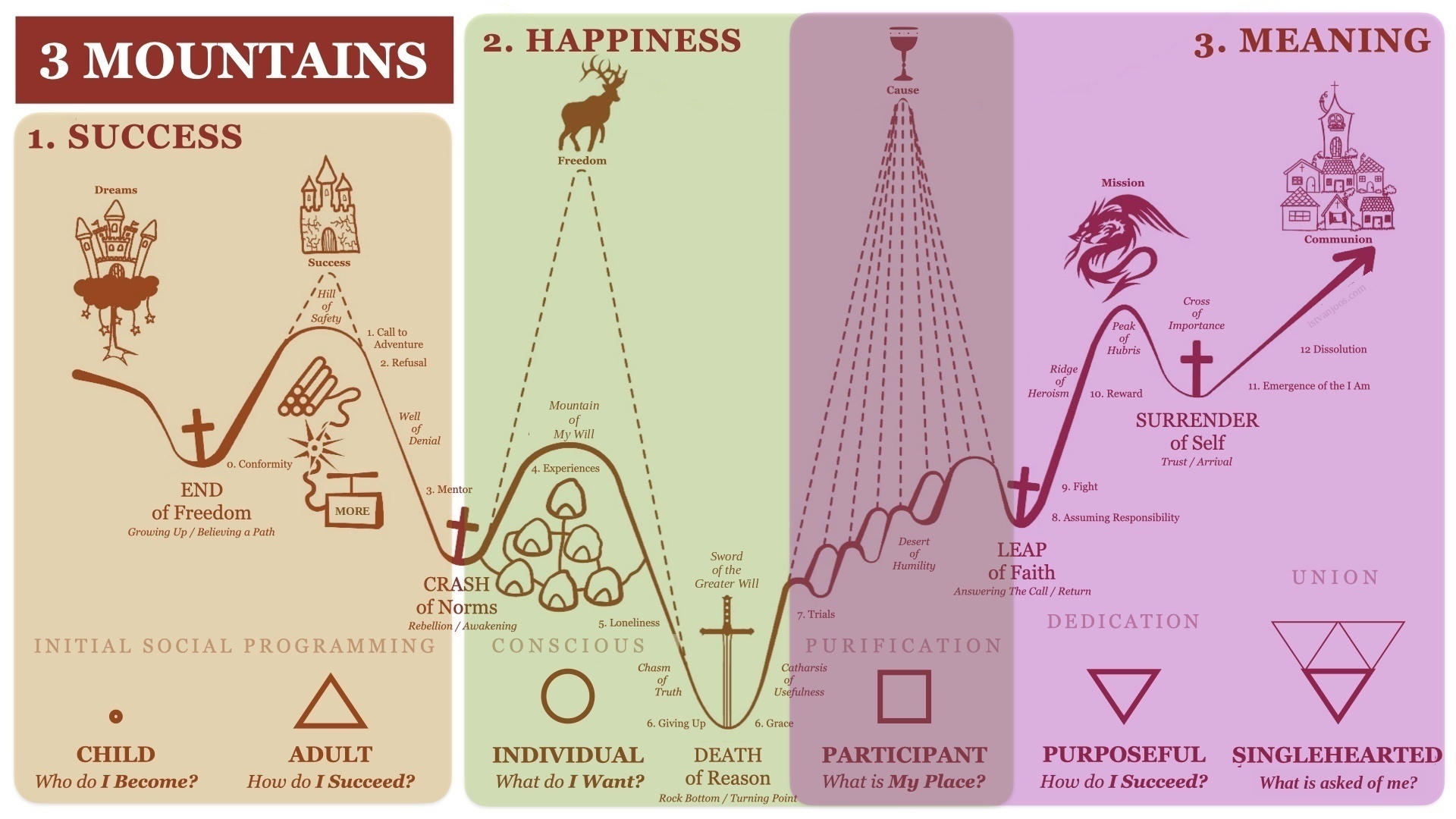
This is the public map: enough to understand the shape, inspect the terrain, and approximately locate yourself. The full map with all the details is for people who've decided to work with it.
First the shape, then the terrain.
The shape of the journey — three mountains, two valleys, one order, and the shortcut that fails.
The terrain — the Three Mountains map. Six stages, each with its question. Five thresholds, each a crossing. Twelve landmarks. Every crossing on this map is a death — of freedom, of norms, of reason, of self — and I mark deaths with crosses. Click to enlarge.
Named after what you're longing for, not what the mountains are made of.
I didn't name the mountains after their contents. I named them after the wish that makes a person start climbing, because that wish is the first thing you can honestly answer about yourself.
Mountain I
Success. The castle, and the prison.
The promise. A good life, as you were shown it: security, standing, a family, work that pays, a place in the world.
The climb. You stop being a possibility and choose a path. You give up the alternatives. You build. I call what you build the castle, and building it is the first real task of an adult. The people who skip it don't become free; they become undefined.
The summit. A life that works.
The valley: prison. Belief in the castle fails. The promise that this would make life good stops being credible, while everything you built keeps you inside: identity, money, family, momentum. Most people here think something is wrong with them. Nothing is. They've finished a mountain. And what they say they want is not meaning, or God, or duty. They say: I just want to be happy.
Mountain II
Happiness. Freedom, and loneliness.
The promise. To be happy — on your own terms, for once.
The climb. What this mountain is made of is desire: you find out who you are by wanting things and going after them. It begins as rebellion, lived rather than thought. You cross a rule you were raised inside. You try your own will, your own version of a good life, and for a while it works. This half of the mountain is enthusiastic — it feels like a new life, and it is. Near the top it becomes authenticity: owning who you are, out loud, at a cost.
The summit. Not happiness. Freedom — a self of your own, which nobody can give you. You can only find it by using it.
The descent. Then the mountain turns, and for most people the second half is not a descent but a painful stumble. The desires that built the self stop delivering. The search turns inward — self-knowledge, the slow work of meeting what you had pushed into the dark — and the honesty that brought you here starts to cost more than it returns. The difference between falling and descending is almost entirely whether someone who has been down this mountain is with you.
The valley: loneliness. You are free, and you are alone. Self-will has stopped delivering, the search turns inward, and the last thing the self can still do is enact the truth — to be who you are, at an even greater cost. It is the most honest move on the map, and it is still the self trying to save the self. Eventually it runs out. That point I call the death of reason: not the end of thinking, but the end of the belief that the self can solve the self. You get out of your own head. What meets you there — briefly, but unmistakably — is something greater than yourself, and it is the first place a true calling, as opposed to a false one, can be heard. At rock bottom, it is answered. What people here say they want is: I want my life to mean something.
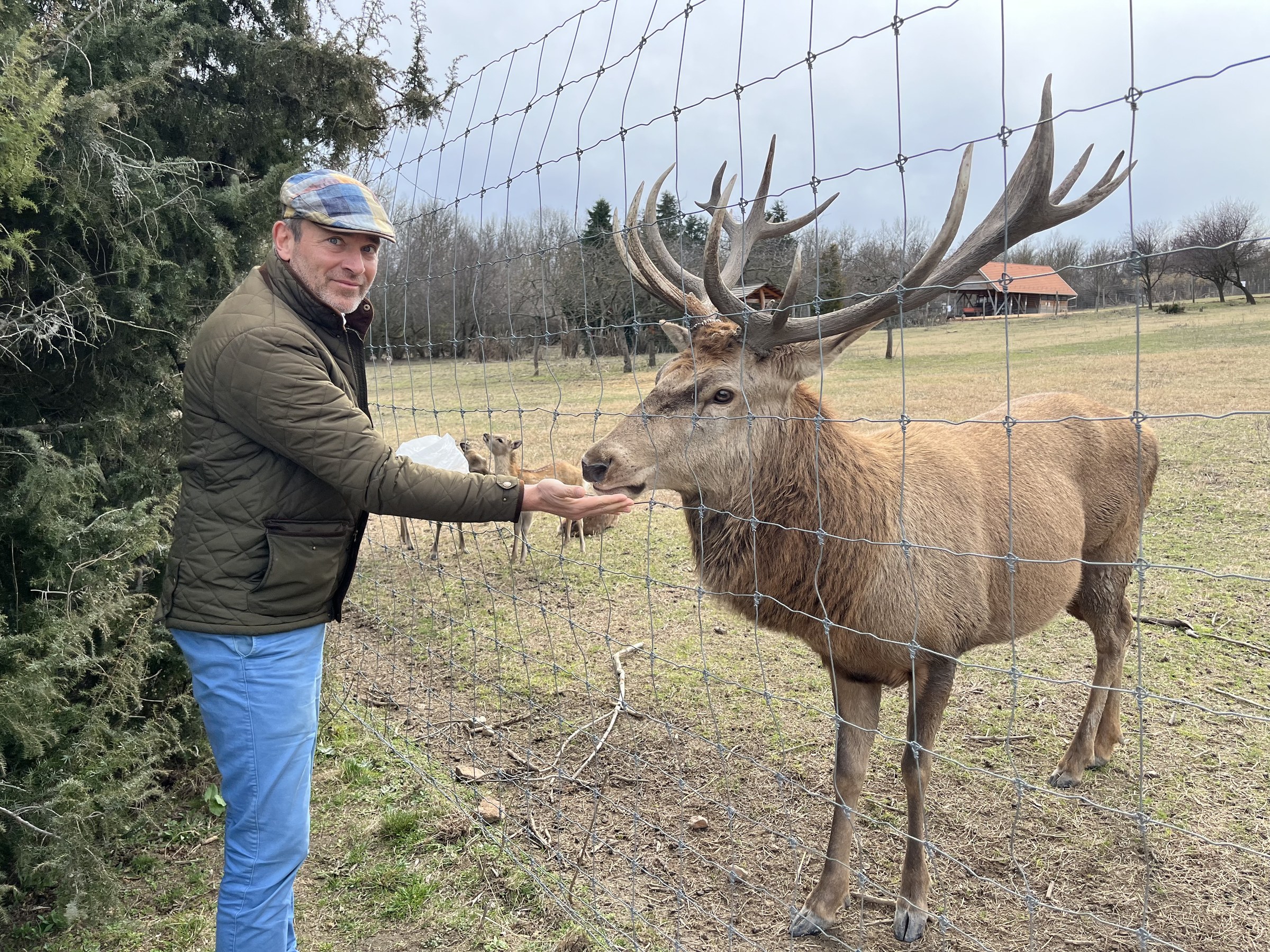
The stag on the map is Freedom. This one is real.
Mountain III
Meaning. A cause, and importance.
The promise. A life that matters.
The climb. The question changes: not what do I want but what is my place — what am I here to fulfill? You give something real, at real cost, into something larger than yourself. It is received and used, and real good comes of it. At first this is unstable and intermittent. Later it becomes a direction, then a life.
The summit. Not a feeling of meaning. A cause — a place where you're needed and used.
The valley: importance. The cause works, and success starts to feed the self. I matter gets mixed into the mission. This valley is quieter than the other two and harder to see from the inside, and the way through it is not a fourth mountain. It is carrying the same responsibility with less of yourself at the center.
Different points on the journey call for different truths.
A person who has never chosen a path needs commitment. A person imprisoned inside an inherited path needs freedom. A person who has found freedom and has nowhere to give it needs responsibility to something greater. The advice is right. The question is who it's for.
The subject — work, a relationship, faith, a cause — doesn't tell you the mountain. The same marriage problem lives on all three.
The shortcut that fails.
Right now one camp of advice tells people, young men especially, that the search for happiness was decadence, and that the cure is to go straight from the castle to the cause: duty, discipline, tradition. I believe in commitment more than almost anything. But when duty or calling is taken up to avoid the descent, it becomes a false calling — not fake, not insincere, but a hiding place. From the castle it looks like Meaning. But it is a Mirage. You climb toward it, but the real mountain is still ahead, with the route running down through the forest you were afraid of. It looks like devotion. It feels like duty. And it breaks at the first demand the rules didn't anticipate, because the person has not yet become free enough to make the right decisions beyond the rules.
You are not culpable for being afraid. You are responsible for what you call the fear. You cannot skip the second mountain. And, for the other camp, you cannot live there.
How to know you've actually crossed.
Transition
What doesn't prove it
What begins to prove it
What confirms it
Out of the castle, onto the second mountain
Complaining about your parents or your culture; consuming self-help
A rule you were raised inside is actually crossed, and it costs you something
Your life reorganizes around choices you made yourself, and it stays that way after the novelty fades
Off the second mountain, onto the third
Saying service matters; a spiritual insight; naming a cause
Something real is given, at real cost, to something larger, and it is received and used
Real good comes of it, and it changes how your life is organized afterwards
Into a stable cause
Declarations; strong belief; one big sacrifice
Sustained work and responsibility; contribution welcomed again and again
A clear direction, a structure that works, and a life that can sustain itself inside it
Locate yourself
Three questions to begin with.
01
What do you currently expect a good life from?
Not what you say you value. What you actually organize your days around. Achievement, security, standing: first mountain. Freedom, authenticity, understanding yourself: second. A place, a cause, being used for something: third.
02
Do you still believe in it, or has it run out?
Climbing and descending feel completely different, even with the same view. Ascent is effort with a point. Descent is effort without one. If what once motivated you no longer feels alive, you're in a valley, and valleys are where the next mountain begins.
03
What happened afterwards?
For any transition you think you've made: not the insight, not the decision, but the consequences. If nothing changed, you had a thought. If something changed, you crossed something.
This is a practitioner's map, drawn from a thousand lives over more than twenty years. It is not a validated psychological instrument, and I say so on purpose. I'm probably wrong about pieces of it. I'm not wrong about the order, and I'm not wrong about the middle.
If you want to go further
The map is free. I am available if you need me to help you navigate it.
Basecamp — seven days to understand the map and find the path that's relevant to you. In preparation.
The Guided Group — small, twelve weeks, join fellow travellers, with goals and accountability.
Private Consultation — a single private session to place you on the map and orient the next step.